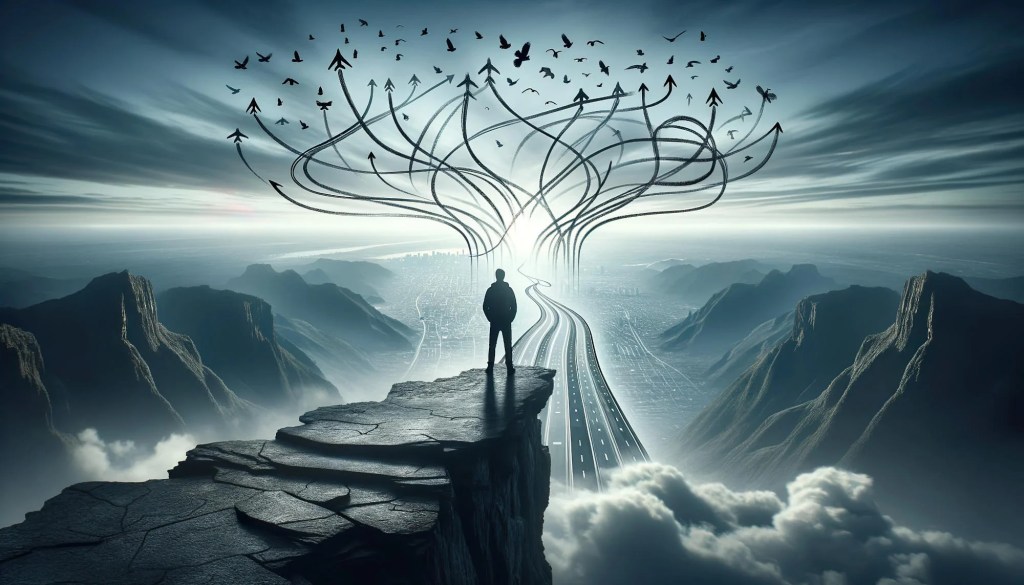
For many years, the greatest philosophers have been debating about the concept of Free will. Does Free will exist? If yes, then to what extent does it exist? If not, then what is the meaning of this life? To understand whether free will exists or not, we first need to understand what free will actually is. Free will can be generally defined as: ‘be the ultimate source or originator of their actions’, or ‘the power of acting without the constraint of necessity or fate’ (according to Oxford dictionary), or ‘choose between different possible courses of action.’
CAUSE AND EFFECT THEORY:
According to the Big Bang theory, the Universe began about 13.8 billion years ago from an extremely hot, dense state. It rapidly expanded and cooled, allowing matter to form over time. As the Universe continued to evolve, gravity pulled matter together to form galaxies, stars, and eventually planetary systems, including our own Solar System.
Life on Earth began billions of years ago with a single-celled organism, and over an unimaginably long span of time, it gradually evolved into the complex forms of life we see today. Eventually, through continuous biological evolution, humans emerged. Across thousands of generations, human ancestors endured extreme hardships: harsh environmental conditions, threats from wild animals, diseases, natural disasters, famines, and wars. At every stage of this long chain, countless lives were lost. Now consider this: if even one of your great-great-grandfathers or ancestors had died due to disease, starvation, accident, or war, the entire chain leading to your existence would have been broken. In that case, you would not exist today.
When thousands of sperm cells are released, they all compete in a race toward the egg. Yet only one succeeds in fertilizing it. That single successful sperm determines the beginning of a unique human life ‘you’. If a different sperm had reached the egg instead, a completely different individual would have been formed. That person would have had different genetic traits, personality tendencies, behaviors, and life experiences. In essence, a completely different “you” would have existed.
This is where the cause-and-effect theory comes in. Everything that has happened has a cause from the previous moment and an effect that leads to consequences in the future moment. There is almost nothing in this world that has happened without cause and effect. Now let us go back to the definition of free-will that we discussed in the beginning ‘be the ultimate source or originator of their actions’. If everything from the origin to the end of life is based on cause and effect, patterns and cycles (I have discussed this in my previous article: The Eternal Cycle, please go through it), how can a person be the ultimate source or originator of their actions? So this definition itself is a paradox for free will.
RIPPLE EFFECT AND DOMINO EFFECT:
The ripple effect is the phenomenon where a single event or action creates a series of indirect, expanding consequences that spread outward over time and across different areas. The domino effect is a chain reaction in which one event directly triggers a sequence of similar or connected events, each one causing the next in a linear progression. Both these models fundamentally help us not only to understand the patterns and chain reactions but also to understand free will.
A war breaks out on the other side of the world, driven by the political and economic agendas of powerful leaders. As a result, global oil and energy prices rise, stock markets begin to fall, and economic instability spreads across countries. Far away from this conflict, a man sits in another corner of the world, completely disconnected from the war itself. He has no involvement in it, no influence over it, and no role in the decisions that caused it. Yet, despite this, the consequences eventually reach him. His company begins to struggle under rising costs and financial pressure. Unable to sustain salaries and operations, the company is forced to lay him off. Suddenly, the man loses his job. He now finds himself worried about how he will support his family, pay his bills, and secure his future. He did not participate in the war, he did not make any economic decisions, and he did nothing that directly led to this outcome, yet he still suffers its consequences.
This raises a profound question: Where, in this chain of events, is free will?
Let us take another example, A person born on one side of Korea can have a good education, eat good food, doesn’t have to worry about survival, get married, have kids, lead a good life, and die. But a person born just a few kilometers away on the other side of Korea will have to suffer their entire life, eating good food is a dream, getting good sleep is a luxury, every day is a survival quest, and they cannot even have their own haircut. Again, doesn’t this raise the question about free will? Every person’s habits, way of life, choices, character, thoughts, behaviour, actions, interests, personality, appearances, and everything is based on the place they were born, who their parents or family are, what religion they are, what conditions they grew up around, and what are the experiences they have seen in their life.
I had an interesting argument with my friends about free will a few days back. When I asked them the same question above, one of them explained that free will still exists in a country where survival is hard. Even within the limited options they have, for example, within the limited options of haircuts they have, they still get to choose which one they want to have, which is again free will for them. Because we are living somewhere else and have more freedom than them, we are viewing free will as something they don’t have. But if we see from their perspective, they have free will in their mind, even within that small bubble, and they get to decide what they want to do with it, which is free will. The argument he gave is interesting, but if you look at a deeper level, free will inherently means “the power of acting without the constraint of necessity or fate.” If the choice they are making is under the constraint of necessity or fate, within the limited options provided to them, it is not free will anymore. His interpretation of free will does not align with the widely accepted definition of free will.
Then I said, I bought an iPhone because it has a status symbol. I was told or influenced that this phone is cool and unique; otherwise, I wouldn’t have bought it. I would have bought a different phone. I came to Dubai because I was influenced to believe that Dubai has good opportunities in terms of career and a better lifestyle, so coming to Dubai was not purely my choice; it was influenced. Everything we choose to do is basically because of the influence of other people, society, our past experiences, and all the other reasons I have already mentioned. One thing affects another and leads to something else, just like a ripple effect and domino effect, and ultimately, we make a choice based on these influences. One of my friends said that yes, somebody might have told me that the iPhone is cool and has a status symbol, but there was still an option for me whether to buy it or not, and I chose to buy it. Nobody forced me to buy it. I could have still bought Samsung, but I did not because clearly I had a choice. I have come to Dubai because I was told or influenced that it has good opportunities, but I still could have gone to any other country, and I did not. I still chose to come to Dubai because I have free will. Basically, he was talking from the perspective of one of the definitions of free will that we read earlier: “choosing between different possible courses of action.”
Yes, even though I was sold a story, influenced, or persuaded, I still had the option to buy any other phone, go to another store looking only for iPhones, or buy online. Let us say I chose to buy Samsung instead. That doesn’t necessarily erase my fundamental desire to look cool or own a status symbol, right? My desire to own a unique phone with good features is still the same; only the product has changed. And the product I chose would ultimately still be influenced by family, friends, my affordability, and my idea of what kind of phone I want. I will explain with a simple example. Let us say I went to a fruit market to buy apples because I thought I should eat some healthy food. There were no apples in the store, so I decided to buy strawberries. You might say I had the option to buy strawberries or come back empty-handed, and I still chose to buy them; that is my free will. But I would say even that decision to buy strawberries was influenced by my previous thought of buying fruits and eating healthy. My fundamental thought of health consciousness did not change; only the product changed, and that product choice is still influenced. Why did I not buy bananas or kiwi? Because again, it depends on taste, preferences, affordability, availability, and many external factors. Similarly, with the Dubai example, I still chose Dubai. Yes, I could have gone to any other place, but doesn’t that evidently show that I actually chose the option that I was most influenced toward, compared to other options?
All companies and brands market their products in such a way that they influence our choices. They study human psychology, create value in our minds even when we don’t need it, and make us buy things. Even the chips packet we buy, the taste, the crispiness, the sound it makes when we are eating it, its packaging, everything is carefully studied, analysed, experimented with, and manufactured. All these companies shape our behaviour into buying things which we believe we are buying out of our own will, but in reality, we are only being influenced. The way we should dress, the way we should, the apparel, the jewellery, our holiday trips, everything is influenced. Alcohol, smoking, and drugs are never a choice. Nobody starts drinking or smoking willingly, but we were all brainwashed to believe that we are doing it by choice. When I’m talking about not having free will, it necessarily doesn’t have to be coercive, or that we are being controlled; it could even be influence, persuasion, or brainwashing.
THE ILLUSION
Humans are the only animals on this planet who can collectively agree on imagined concepts such as money, nations, borders, marriage, and legal systems, assign value to them, and organize their lives around them. We have created a world structured by morals and responsibilities, systems that may be abstract or constructed, yet they exist because we need a framework to live together in an organized society. If there were no concept of money, perhaps I would go wherever I want, travel freely across the world, and not feel the need to work, earn, save, and then travel. I would simply do what I want and go wherever I wish.
To this, one of my friends countered by saying: If you do not earn money, how will you move from one place to another? If you want to travel by ship, for example, you first need a ship, someone to operate it, fuel, and many other resources. Either you must put in all the effort yourself, or someone else will do it for you, and in that case, you must pay for it. That is why money exists, and that is why you need to work to earn it.
Interestingly, his argument actually supports my point. That is exactly what I am trying to say. To travel from one place to another, I either need to put in all the effort myself or pay someone else to do it. But I cannot realistically put in all the effort myself; I do not know how to build a ship, I do not know how to sail, and I lack knowledge about fuel, navigation, and many other technical aspects. All of these are prior conditions and limitations. As a result, I am compelled to choose the alternative: paying money. But to pay money, I must earn it, which requires working and saving. Each step is not an isolated choice, but part of a chain of causes and effects.
Hence, we can see that everything is interconnected, and every decision we make is embedded within a larger system of constraints, influences, and dependencies. We have created so many illusory systems around us and progressed so far within them that we are now required to live according to these constraints, whether we like it or not. Everybody says that we can choose what we want to do and how we want to live, but how many of us actually live that way? Even humans have come to accept that this is what life is, and we have limited ourselves to believing that we are living according to our own will.
Then one of my friends raised an important question: what about people who commit crimes or do harm to society? A person who has committed a murder could easily say, “I did not do it out of my own choice; I did it because of my circumstances, external factors, and other influences. So why should I be punished if I was compelled?” This is where we need to draw a distinction. Yes, various factors may have influenced his actions. However, because the act is harmful to society, consequences are necessary; the person needs to be punished so that he will not repeat it again, or someone else will not repeat it after him. There must be consequences for actions. These consequences, in turn, are part of the structured systems we have created: laws, rules, and social frameworks, which, although constructed, play a crucial role in maintaining order. And once again, these systems influence our lives in significant ways. If there is a cause that leads a person to commit a crime, the act itself becomes the effect. And in response to that act, legal punishment becomes another effect within the same chain of causation. Humans are social animals who live in harmony, and if anybody disrupts the harmony with bad intentions should be punished for the survival and for the sake of a better society. ‘Accountability matters for the collective stability.’
INTERNAL AGENCY:
The human brain can be broadly understood in terms of conscious and subconscious processes, where 95% of the decisions we make are taken by the subconscious part. Only 5% of the decisions are taken by our conscious mind at the cognitive level. Our organs, like the heart, lungs, liver, and blood flow, keep functioning without us having to think about them. In a similar way, our brain is constantly working in the background, shaping our thoughts, emotions, habits, and behaviours without our full awareness.
These subconscious patterns are built over time, through our past experiences, childhood conditioning, emotional experiences, and the values and norms of the society we grow up in. So, in many ways, what we think and how we act is already influenced before we even become aware of it. And also, the conscious mind does not create choices from nothing; it operates on options that are already influenced and filtered by the subconscious. We may feel like we are making a deliberate choice, but that choice is still coming from a system we did not consciously design. And this is where the question of free will becomes uncomfortable. If our thoughts, preferences, and decisions are being shaped by processes that we don’t consciously control, then how “free” are our choices really? What feels like a personal decision might actually be the result of a chain of influences and past experiences that were already in place before we even made the choice.
CONCLUSION
We often think that we have free will when we look at life from our individual perspective. It feels like we are the ones choosing, deciding, and controlling our direction. But if we zoom out and look at life from a larger perspective, this certainty starts to dissolve. We are not isolated beings making independent decisions; we are deeply interconnected systems, constantly shaped by forces within us and around us: our upbringing, biology, environment, society, and every experience we have gone through. Everything is layered, inter-aligned, and tangled in a continuous chain of causes and effects.
From this broader view, the idea of control becomes difficult to defend. A large part of what we call “choice” seems to emerge from conditions we did not create and cannot fully escape. This does not necessarily make life meaningless, but it does challenge the belief that we are fully independent authors of our actions. When we start to understand that every person, including ourselves, is shaped by circumstances, influences, and experiences beyond their control, the idea of blaming others or even blaming ourselves so harshly begins to feel less reasonable.
In the end, life may not be about absolute freedom or absolute control, but about an ongoing unfolding of causes and processes through us. And maybe the most honest way to live with this understanding is not through blame, judgment, or guilt, but with a clearer awareness that everyone is simply navigating the conditions they have been placed in, inside a system that is far bigger than any individual choice.
 Inkwellery by Abhi
Leave a comment